Related Posts with Thumbnails
Showing posts with label life and death. Show all posts

Howard vs. Rudd: the webcast

This year Australia goes to the polls to elect a new federal government. Whichever party wins the most seats can form government, and their leader becomes the Prime Minister. John Howard has been Australia's Prime Minister for 11 years as leader of the Liberals, and Labor leader Kevin Rudd is challenging him.

On Thursday night the Australian Christian Lobby organised a live webcast of the two leaders speaking to churches. Many churches across Australia signed up to watch this event. I attended the webcast at a local congregation.

Mr. Howard spoke first, then received questions from church leaders in the audience. Mr. Rudd's presentation followed the same format. Both leaders began their speeches with a commendation of Australia's Christian heritage. Both also professed to hold a Christian faith.

As a former political science student, I was very interested to note the way that the two leaders framed their speeches to focus upon their key concerns. They spoke partly to their audience specifically, but also treated the webcast as another opportunity to press home their platforms on issues such as the economy and workplace reform. It was also very interesting to listen to each leader for 20 minutes or more, as usually we hear only soundbites on the news.

In my opinion, Mr. Howard made more effort to justify his policies and practises to the Christian public, and respond to complaints against his party. Especially in the area of welfare and the workplace, Mr. Howard sought to demonstrate that he does care for the underprivileged.

Mr. Howard also made more effort to explain the way his faith impacts upon his decisions, and pointed out that his party includes many strong Christians. He mentioned that he and many other members of the Liberal party voted conservatively on issues such as stem cell research.

Mr. Rudd's speech was much more humorous! He made serveral jokes about parts of his speech being pitched to various Christian denominations. For example, he stated that including a quote from John Wesley was "a pitch for hte Methodist vote". I enjoyed Mr. Rudd's humour.

Mr. Rudd also did a good job of focusing on some alternative issues to those Mr. Howard promoted as important. For example, he spoke about the effects of the Iraq war upon the Christian minority in that country. He also emphasised the importance of helping refugees. Both these issues pull my heart strings, and I am sure they have a similar effect on many other Christians.

During the question time, church leaders asked Mr. Rudd questions that were very relevant to the past history of the Labor party and the future of the country. For example, his stance on anti-vilification laws.

However, I was disappointed that no one asked Mr. Rudd for his personal stance on issues of life and death. His record on issues related to abortion is poor, and it would have been worthwhile to ensure that voters were aware of this.

Overall, the "a word" (abortion) was not mentioned in the entire webcast. This shows the low priority placed upon this issue in Australia, including in church denominations, in comparison to the high priority that is placed upon it in the USA.

In conclusion, this webcast provides much for Australian Christians to be grateful about. It is wonderful that we have leaders in both major parties who are willing to profess faith in Christ, speak to Christians, and acknowledge the right of Christians to be involved in public life.

It is also excellent that Christians are becoming more politically aware and wanting to vote in accordance with God's will. One of my favourite parts of attending the webcast was the break in the middle of it, where we prayed together. Many churches across the nation did the same. I am certain that this was the most powerful part of the evening. God will surely work, and reveal to us what we need to know about our leaders, in response to our prayers.

Read more...

Around the Internet

My friend Felicity has a new blog, In God's Strength. Her goal of cultivating thankfulness through her blogging is a good one, and her recent posts reflect this aim.

I haven't been able to visit Kimi's blog for a long time, and when I visited today I was sorry to read that she is still enduring a lot of sickness. In her most recent post, Humility through illness, Kimi shares this about her illness: "It has been a constant reminder of my own weaknesses and how much I need God and other's help. If I had the perfect picture home, kept up on everything all the time, and was able to meet everyone's needs constantly, I could feel like I had "made it" and get prideful about myself. Sometimes you see this tendency in some of our Christian leaders-the desire to paint the picture perfect family. This is dangerous ground to be on and will more tend to discourage instead of encourage others. I personally find that I am most meaningfully encouraged by leaders who share God's grace and abundance to them through their own weaknesses". I recommend reading the whole post.

My friend Mike is aiming focus on encouragement through his blog. I appreciated his recent post on our pastor Mike and his wife Nikki . He explains the encouragement they have brought to his life. I have also been encouraged by their lives, especially Mike's humility in admitting where things have gone wrong in the past.

Susan has written a response to an article that was negative about marriage. "Silly Me" explores the self centeredness of many reasons why people avoid marriage, and offers "10 fascinating benefits to being married" as a response. I have noticed that many reasons Christians give for why they are happy to remain single are also self centered. So are most of the things Christians say to people who are not happy about being single. For example, "you have so much more time and you don't have to take care of others". Yay! What a great time in my life to value my individual freedom and autonomy so I can become more and more selfish and less willing to adjust to the serving that is necessary in marriage! [Read sarcasm, please!]. Of course, Christians can always bring out 1 Corinthians 7 . . . but I think most of us know that the reason we are not married is not because we are serving God better that way! I hope to elaborate further on this topic in future.

Finally, please drop over to Feminists for Life. These ladies are the type of feminists that I like.

Read more...

Defiant Birth: Women Who Resist Medical Eugenics by Melinda Tankard Reist

If you are anything like me, you come back from overseas holidays inspired with little resolutions. I have been totally jetlagged, but also determined to throw away clothes I never wear, re-arrange my room, and write about books. For someone who reads an enourmous amount, I have very few entries under the "books" label on my blog.

So today I want to draw your attention to one of the best books I read last year: Defiant Birth. This book contains many stories of women who chose to give birth even though the medical profession advised abortion. There is a lot of pressure in Australia and other Western countries to abort disabled babies. There is also a lot of pressure on disabled women to have abortions. I cannot explain the book better than the author does at the start of her long introduction:

"It is about women who were told they should not have babies because of perceived disabilities - either in the child or themselves."

"This is a book about women who have resisted the ideology of quality control and the paradigm of perfection."

Melinda Tankard Reist ably exposes the limitations of the testing used to diagnose babies before birth, and the way women are "being forced to make agonising decisions on the basis of inadequate - even inaccurate - information."

I have a long term interest in working to reduce the number of abortions, as I see abortion as a tragedy for women and children. A tiny baby, recognisably human, is destroyed in every abortion. Many women carry the scars of this choice, often a coerced one, for the rest of their lives. In an abortion done for reasons of disability, the woman often carries the extra grief and guilt of the late abortion of a baby she originally wanted.

It is impossible to attempt to combat abortion for long without realising that our society presents to women a huge number of times when it is "wrong" to have a baby. You can be too young, too old, too busy, too ill, not educated enough, too poor, or have too many children already. If you have a baby at such times, many people deem you unwise or just plain stupid. Couldn't you have planning things better? With such thinking, the majority of time in a woman's reproductive life is defined as the "wrong time".

As I have realised the pressure this places on women who are pregnant in less than perfect circumstances, I have become an unashamed pro-natalist. This means I am positive about people choosing to have children! I object to the basic idea that their are lots of bad times to have babies. Usually, the bad times are socially created and with the right support women can get through their pregnancies and even thrive. Children should be welcomed, even in difficult circumstances.

Melinda Tankard Reist explores the way movements promoting birth control, genetic engineering and selective abortion have been fuelled by eugenic ideas. Eugenics can be defined as the idea of improving humanity by encouraging the strongest and most intelligent to reproduce and the weaker and less intelligent to prevent reproduction (page 304).

I object to the eugenicist idea that women "ought" to surgically (sterilisation, abortion) or hormonally (the pill and other hormonal birth control) alter their bodies to prevent children. Women have no duty to do this. Some people wrongly interpret my pro-natalism to mean that I oppose all birth control. I find myself needing to assure some people that I am not on a campaign to ban condoms! I do oppose any birth control that acts to prevents the implantation in the womb of an already conceived human being (hormonal birth control such as the pill is included in this). I also hold the view that welcoming children is generally preferable to preventing them, largely because I believe the Bible presents fruitfulness in the context of bearing children as a blessing.

Defiant Birth rejects the idea that women "ought" to prevent themselves from giving birth under circumstances society deems unacceptable. It does so in a way that is intellectually satisfying. Tankard Reist's exploration of society's attitudes to reproduction, disability and difference is brilliant. Reading this book was also a powerful emotional experience. I found myself uplifted as I read about women who had chosen life under difficult circumstances. If you have read Melinda Tankard Reist's Giving Sorrow Words, and wept as you read the stories of women's grief after abortion, you will find that this book is an opposite experience emotionally. You might want to cry with joy as women choose life!

This book was also personally encouraging in the context of my own minor disability. I have chronic back pain, and this often causes me to fear pregnancy, birth and raising children. Will these seasons in my life cause my pain to get much worse? Will I have less children than I would like as a result? I cannot know my future, but after reading this book I was encouraged. I realised that many women who suffer from much worse disabilities than my own have children. Johanne Greally's story particularly impacted me. Johanne chose to have five children despite a back problem which was far more severe than my own. She wrote: "All of them have been worth the pain. Pain is finite . . . set against the cherished beauty of each of my babies - each of them so totally different but so infinitely loveable - the pain is forgotten. Each child has compensated me tenfold for all I've been through."

I found myself passionately identifying with Defiant Birth on nearly every page. Read this book. It will make you aware of where our society is headed. It will challenge your eugenicist assumptions about who should reproduce and who should be born. It will inspire you to encourage and support pregnant women. It will empower you to believe that having babies is really OK. Giving birth is what women have been doing since Eve, and it is not a disability.

Read more...

Abortion stories

Last night I watched a TV show on abortion. I often avoid watching these shows, because they tend to make me upset. In fact, I usually avoid TV altogether! The last time I sat down to watch a TV show was about two months ago with my friend Ruth. Her sister is expecting twins as well, and the show was about identical twins.

The program I watched last night was well made. Those who shared their experiences were presented against a black background, with light just on their faces and torsos. Five women and one man were featured. The interviewer did not appear in the documentary at all: he or she was invisible and silent. This gave the effect of being confronted simply with the person who was sharing. The testimonies were interspersed briefly with scenes of cityscapes underneath a dark sky, and occasionally with other images such as children enjoying swings. White text on a black background presented small amounts of information that gave the context for what the person said next.

Although I have heard that the maker of the documentary is pro-life, this was not overt. There were testimonies from those who regretted and repented of abortion, and from those who justified their decisions or were at peace with them.

I appreciated the way the documentary maker had presented each person in the context of other aspects of their lives. For example, it is hard to demonise a woman who feels no guilt for having two abortions for financial and career reasons when we know she is also a loving wife and devoted grandmother. To be pro-life, yet still present people we disagree with in the fulness of their humanity and without counter argument is courageous and powerful. People who have abortions are people just like you and I, who are deceived into thinking abortion is the best or only solution. Many of them are the sort of people you'd enjoy talking to at a dinner party.

Despite the fact that the interviewer's position was not overt, I think a strong pro-life perspective came out. One woman strongly justified her abortion, yet she is now childless at 45. Her tears over her childlessness spoke volumes for the emptiness of justifying her choice to kill the only child she will ever have. In another testimony, a woman who felt no guilt for her abortion said something that I found deeply profound. I do not remember her exact words, but the essence was that having a child is about relinquishing control and in doing so allowing life to flourish.

For me, the documentary brought to mind again ideas I have thought much about already. I was grateful to be able to discuss some of these ideas with Dave over the phone after watching it.

The more stories of abortion I hear, the more convinced I am that this will not end unless people choose not to enter sexual relationships where they are completely unprepared to have a child. If you are not ready to have a child, you are not ready to get intimate. A logical deducation of this is that if you are not ready to have a child, you are not ready to get married. In Australia, married women as well as single women have abortions in large numbers. If abortions are to reduce, people at least need to have a viable back up plan if their plan number one (no baby right now) does not work out. Otherwise they feel they cannot continue the pregnancy.

The debate over abortion is not really over whether or not the baby is indeed a baby. Those who justified their abortions knew they were justifying killing a person. They did not attempt to argue that what they did was anything other than killing, they argued that it was an OK form of killing.

When considering abortion, it is important to realise that we cannot make a judgement of what someone's quality of life will be. Those who justify abortion do so on the basis that the child would not have a good life if it was born. Several women mentioned that they did not want their child to suffer what they suffered. One mentioned poverty, another the lack of a stay-at-home-mother. The question that needs to be asked in these situations is "would you rather be dead?". I doubt their reply would be yes. We all suffer pain. Justifying abortion on the basis that the person would suffer makes us all candidates for termination. There is no way of planning everything out to avoid suffering.

There is no ideal, perfect time to have a baby. However, most people who have abortions do so on the basis that it is "not the right time". They hope to have a baby some day, just not now. The woman who is childless at 45 wanted specific things to happen before she would be "ready" to have a child, and in the end that time never came. In aiming for an ideal, she ended up with nothing. Usually, the ideal time is realted to financial circumstances. I find it ironic that in one of the richest cultures on earth, we feel we cannot afford children. In past generations, people had more children with less money.

Finally, in all this I am reminded of the gospel and I am aware of my own sin. In my pro-life efforts, I want to present the gospel of grace to hurting or deceived people. I still do not know how to do this well, but it is my desire. We should feel a deep compassion for those who are without God to turn to in circumstances of distress.

I am deeply grateful to serve a God who teaches us what is true and good. The Bible tells us that we do not have ultimate control over the womb, it is God who opens and closes it. Marriage is the relationship in which to pursue love and intimacy, and we are to avoid unwise and ungodly partnerships. Children are a blessing and a reward, and they are to be accepted with joy within marriage. Indeed, one of the reasons God created marriage is that he wants us to have them! Without God's revelation, I would not know these things. It is wonderful to serve a God who not only has a great plan for how things should work, but who graciously reaches down to save us from our sins and set us on the path to a flourishing life.

Read more...

Steve Irwin's death

Here in Australia, the death of Steve Irwin is a frequent topic of conversation here in Australia. Even I have nearly shed a few tears over the descriptions of his death, and the fact that they have footage of it, and I definitely would not describe myself as a fan! I know that Irwin's death has also been big news in the USA, as he was even more popular over there.

Apparantly Steve Irwin's widow Terri is a Christian and she homeschools using the same curriculum that I use where I work. So we can be praying that she will find her comfort and strength in God.

I was interested to read a story on the Creation Ministries International about Irwin's death. In some ways it seemed insensitive to use his death to put across our own religious ideas. However, we all have to make sense of death in some way. I have read numerous articles in The Australian exploring the death from various perspectives. Explaining how various ideas can be answered and understood from a creationist perspective is helpful. Check out the article: The stingray of death.

Mike Jolly has also written about death in the context of Irwin's unexpected demise. Check out his article here. As he says, what are you living for? Is life all about doing what you love, or is there something more?

Read more...

Joy in life and death

Dr. David Menton's talk on the DVD
Fearfully & Wonderfully Made
explains in detail the beauty of our beginning. Many people, Christians included, speak of some pregnancies as accidents or mistakes. As Dr. Menton explained all the processes that are necessary for a human being to even come to the stage of conception, it became clear that this could never be so. God has designed the human body with the intention that conception will occur. If one process is not working properly conception becomes unlikely or impossible. The parents may not have planned a baby, but God did.

After conception, human survival is just as remarkable. The walls of the womb must be hospitable for the child to implant. Unfortunately, some birth control devices including “the pill” not only interfere with pre-conception processes but also change the lining of the womb so that the tiny human being is much less likely to be able to implant. Considering this, it is even more amazing that we are here! The processes of a child’s conception and implantation happen without a woman’s knowledge. The beauty of the child’s beginning, and often its premature ending in the womb, is unknown to her. When a child dies before birth, whether the death is known or very early and unknown, we often mourn the person less than someone who dies after birth. This is not because the person is less valuable to God. It is because we know him or her very little.

For most of people, the beauty of a child’s beginning starts to sink in with the first ultrasound. As one uncle excitedly declared to me, “there is a little person in there”! The suspense and excitement builds as the birth draws closer. In my family, no one has found out whether they are having a boy or a girl through ultrasound. Even my sister, who is having twins, has decided to keep it a surprise. The anticipation is wonderful! After birth, the beginning person is still largely a mystery. What a joy it is to watch them grow. Wispy strands of hair, which never seem to grow much, somehow turn into ringlets. Chubby legs become lean. The person becomes known, and all the more precious.

Endings, like beginnings, can be beautiful. A life well lived will lead to a blessed end. My Grandad is an example of this. Granddad spent much of his life serving others, including as a missionary. Close to the end of his life, it was beautiful to sit beside his bedside and hear some of his recollections. A hard worker all his life, Granddad rarely stopped to talk. Yet here he was, in pain and confined to a hospital bed, with time to talk. He told me his favourite Psalm, number 139, and I read it to him. He shared special experiences from his missionary days, including his close friendship with a native man in PNG.

At his funeral, his children and grandchildren rose up to speak during an open sharing time. Their comments showed the foundations of Granddad’s life. As Mum said, Granddad often spoke of how wonderful it is that God accepts us not for what we have done, but because of Jesus’ death on the cross for our sins. Dad spoke of Granddad’s great humility. While some struggle at their parent's funerals to find good things to say, Dad struggled to fit in all he wanted to say of Granddad’s character: reliable, dependable, diligent, gentle, loving, serving, compassionate. The funeral was a celebration. Living well means being Christ focused and servant hearted. I am grateful for a grandfather who demonstrated that such a life leads to a beautiful end.

This post was written for the
Carnival of Beauty. This week's topic is The Beauty of Beginnings and Endings.

Read more...

Apply the Bible

Answering the Call is an excellent small book. The author, John Ensor, is a Baptist pastor. He does a fantastic job of demonstrating why Christians need to actively oppose abortion. John shows how the gospel can, and should, be central to their efforts. At one point, he addresses the argument that “if the Bible does not explicitly condemn something it must be fine.”

Virginia Ramey Mollenkott, professor emeritus at William Patterson University in New Jersey, calls herself an “evangelical feminist.” She claims that “nowhere does the Bible prohibit abortion.” In one sense she is right. The word abortion does not appear in the Bible. Of course, the Bible does not prohibit “driving to endanger” or “domestic violence” or “killing five-year-olds” either, if you demand an explicit listing for something to be forbidden. The Bible teaches that abortion is wrong by teaching that God views the preborn child as a person, and then by calling us to protect the life of all people from homicide.

Christians commonly argue that if the Bible does not explicitly address an issue, that issue is not important or is a matter of individual preference. At one conference I attended, the preacher argued that if the Bible had no explicit prohibitions or commands about a matter "then a Christian's opinion is a matter of cultural preference only." He went on to list 50 things ranging from smoking marijuana to nose rings. He argued that Christians should forsake all "cultural preference" to evangelise. In this version of Biblical application, the Bible is not only irrelevant to huge chunks of life, but Christians have a moral duty to ditch whatever hang ups they have and jump into whatever is happening around them.

The excerpt from John Ensor should demonstrate that such an approach to understanding how the Bible applies to our lives is problematic. Human beings are not only adept at inventing ways of doing evil. They are also good at inventing names for it. To expect an explicit command about a matter, in today’s language and terminology, is unrealistic. Cannibalism is not a word that appears in the Bible, but it does not take a degree in Biblical studies to notice that eating other human beings is not consistent with treating them as God's image bearers. When John G. Paton went to minister in Vanuatu, cannibal tribes lived all around him. When his wife and child died of natural causes, the cannibal tribes wanted to eat them. These tribes frequently ate deceased family members. He had to guard the grave night and day to prevent this. If the preacher at the conference I attended was right, John Paton should have instead joined in the feast.

Arguing that something “must be explicitly listed to be prohibited” not only becomes obviously ridiculous when applied to an action like cannibalism, it also encourages a minimalist approach to applying the Bible. Some of my sisters in Christ would require a Bible verse that stated "Bikinis are immodest" before they would stop wearing them. Other Christians would need a verse saying “watching explicit sex scenes on TV is unholy” before they would stop watching them. Rather than asking "what action would be most consistent with what God has revealed in Scripture", "what would promote holy living", or "what Biblical principles apply to this issue" some Christians are practical atheists. They act in many areas as though God does not exist, or does not care.

Christians should search the Scriptures for guidance in every area of their lives. They should expect that the Scriptures do address the matters that concern them. If there are not explicit commands, there are often principles that can be applied. Any principles or perspectives the Bible does offer should be much more valuable to Christians than what Joe Smith down the street is doing. The alternative to applying the Bible to all of life is to be swayed into all kinds of ungodliness and foolishness, under the guise of Christian liberty.


Read more...

Completely Pro-life?

When I arrived home from Launceston last night, I had a parcel of pro-life books awaiting me! New South Wales Right to Life allowed me to choose some to order from the USA, as part of my payment for working there in January. I ordered eight copies of Randy Alcorn’s book Does the Birth Control Pill Cause Abortions?. I previously only had a PDF download. A friend who read this download asked for several "real" copies. I would also like to have a few on hand, in case someone asks. I have thought of blogging about “the pill” for a few months, but it is one of those topics I don’t enjoy confronting!

In short, medical literature indicates that hormonal birth control has three actions. The first is the one most people are familiar with: suppression of ovulation. The second is changes in cervical mucus, making sperm penetration difficult. The third is changes in the lining of the uterus, which reduces the likelihood of an already conceived human being implanting. These actions are documented in much medical literature, and in the information in pill packets. It is the third action that concerns those us who believe life is valuable from conception.

Rather than write out a lot of information and arguments, I am posting below, in italics and with a few amendments, an email I wrote to someone on this topic.

Thanks also for looking up your book on the pill for me. There seems to be a consensus that the combined pill does those three things, in all the literature I have read and from all the people I’ve asked. The difference comes in interpretation of what that evidence means in terms of whether the combined pill acts as an abortifacient. There is little debate that the mini-pill does.

After talking to you on the phone I re-read Randy Alcorn's book on the combined pill that I have downloaded. He is a protestant pro-life Christian who has done extensive research into its effects (he is not against birth control as such, only against abortifacient varieties). Personally, I think the available evidence strongly indicates that the combined pill acts as an abortifacient. It does so less frequently than the mini-pill, but is still a significant concern. As you wrote, the combined pill is 97% effective. This means three out of every 100 women on this pill become pregnant each year. This happens when all three of the actions have failed. The pill does not always tell the brain not to produce an egg. The question is how many times the first action fails, and it gets to the third action and that works. At a minimum it is likely that this happens at least as many times as pregnancy occurs, and it probably happens more than that.

I hope this helps in explaining where I am coming from in this. I understand that others have evaluated the evidence and come to different conclusions. I have personally really struggled with this information. It is an emotive issue because hormonal birth control is widely used amongst Christians. I’d love to believe that the evidence indicated it did not act as an abortifacient. Right now though, I feel that I need to inform people about the evidence so they can think about it and evaluate it for themselves. I generally only mention it if I am asked though.

I agree that there are ethical issues surrounding all the actions of the pill, and indeed any artificial interference with the natural and healthy processes of our God-given bodies. However, I think that as Bible believing Christians we do need to draw an absolute line somewhere. The most logical place to draw that line is at conception, when an individual human life comes into being.

Some Christians react to information about hormonal birth control with horror at the thought of having more children than they want. This is an unbiblical reaction, because God clearly says that having many children is a blessing. Modern Christians have moved far from this view. Most of them are more certain about the value of preventing children than they are about the value of early life. How sad. This reaction is also uninformed, since birth rates were low before the pill was introduced. You can look up the Australian Bureau of Statistics on the Internet. After the 1800s, more and more people chose to have small families. Hormonal birth control was simply an easier and more effective way to achieve this.

It is difficult to evaluate clearly something we have grown up with and accepted for many years. It helps to have the facts, and to interpret them with a Biblical understanding of children and the purpose of marriage. With the perspective this gives, we can attempt to hold a view that is completely pro-life: even if it interferes with our own desires and plans.

Disclaimer: addressing this topic does not mean I am judging individuals. I believe things like this are private. I try to never ask people whether their children were planned, or whether they intend to have children, let alone whether they use the pill. People who feel judged often at the same time go around telling everyone about their private life. If they don’t want to be judged, maybe they should keep private things private??

Read more...

Feminism's Failure

I recently read part of a biography about an early Australian feminist, Vida Goldstein. I have a long running facination with feminism brought on through attending a university where it seemed to be included in every second class. They thought feminism was fabulous, the liberator of women, etc. I disagreed, and still do. Partly in reaction to what I was taught at university, I strongly oppose most of what they promote.

Here is a quote from the biography, which illustrates the failure of feminism:

“Vida never reconciled the contradictory notions that women would contribute special qualities to the public sphere and that men and women were equal and should be treated equally. There is always the sense that she thought ‘men and women are equal, but women are a bit more equal because they have finer qualities of spirituality and higher-mindedness than men’. It is an appealing philosophy – for women – which is still propounded today: that women will bring the special qualities of nurturing, gentleness, and respect for life into the public sphere."

The promise of feminism simply does not deliver. It would be amusingly ironic, if it was not so sad, that feminism has done the opposite of what proponents originally argued for. Rather than bringing respect for life to the public sphere, women campaign for more ways to terminate pregnancy. This week the Australian Senate approved the transferral of authority for the abortion drug RU486 to an unelected authority, the Theraputic Goods Administration (TGA). If the House of Representatives does not vote down this measure, ministerial accountability for the drug will no longer exist. The TGA has said they plan to approve the drug for importation if authority is passed to them.

Women politicians pushed for this law change. They were the driving force behind it. Australian women were polled about the drug. When told of its dangers in comparison to surgical abortion they did not want it imported.

Feminism promised to give us women who spoke for women, who representated women's interests. Instead, feminist politicans believe women must suppress their own biology in order to be liberated. To them, women must be able to eliminate their babies in order to live as men do. Women's central contribution throughout history, of bearing and raising children, is seen as a threat to their destiny.

Such a philosophy is not pro-woman. Feminist politicians who advocate it do not represent the interests of women, and they will never speak for me.

Read more...

New Year, New Opportunities

I am in Sydney working for New South Wales Right to Life (www.nswrtl.org.au). They phoned me in the middle of last week to ask if I could come up, since a staff member will need to be away from work unexpectedly for some weeks. I can only be here until the 24th, due to my committments as a teacher's aid in Launceston. However, they still wanted to fly me up. So I am grateful to be here, learning a lot about pro-life work first hand! Praise God for unexpected opportunities.

On the pro-life theme, www.ausfamily.org/youth has been updated. There is a link to Christina's great article on RU486. I also have a new article on there. I have explained why the argument that "if something has always been around we should tolerate it" is deeply flawed.

Submissions on RU486 to the Senate inquiry are due today - there is still time to quickly write one tonight!! I sent mine in this morning, after having to a new one because the first was left on my computer at home! Complete and carefully written, sitting there unsent. That is what happens when you fly off at a few days notice!

Read more...

Am I a Closet Catholic??

A person who called herself "Yabby" on an Online Opinion message board, recently accused me of being a Catholic solely on the basis that I am pro-life. Even after I told her I was not, she persisted in saying I must be "connected". Yabby looked up my blog and then wrote that I had a whole heap of anti-abortion people listed, most of whom have links to the Catholic church. Hmm. Perhaps she doesn't know the difference between Catholics and protestants. As a protestant, I am nearly as likely to be criticisized for being actively pro-life as encouraged. Two people have told me to make sure I note that what I'm doing isn't really useful, as if I do "save any babies" they'll probably grow up and go to hell. Many people are encouraging too, but there is certainly a lot of feeling that I'd be better off spending the time I take on pr0-life work "preaching the gospel". I don't mind these friendly reminders. They help me keep anything I do about abortion in perspective. The gospel is indeed far more important.

My exchange with Yabby reminded me of emails I received last year as the President of Students Organised to Uphold Life at the University of Tasmania. When I received the following emails, I sent them on to a few Catholic SOUL members, and they found them extremely funny. Here is my correspondance with our critic:


The original email, titled “Message for SOUL”, on 5 March.

get your rosaries of our ovaries

6-3-05

Hi Danielle,

Thank you for your message. I can assure you that we at SOUL have absolutely no interest in your ovaries. Nor do the majority of us have any interest in rosaries. Some of our members are Catholic, but they do not make up the majority.

Your cute rhyme represents a common stereotype, but it really has absolutely nothing to do with what we are trying to do.

Pro-life people are commonly assumed to be solely religious, but that is just not true. See these two sites if you are interested.
http://www.godlessprolifers.org/home.html
http://www.geocities.com/CapitolHill/Parliament/8383/

From Sherrin Ward.

6-3-05

Ha Ha Ha,

You Catholics should just tell the truth about SOUL
and that is just a recruiting ground for picking up
unsuspecting young catholic girls who will be driven
to a life of submisiveness or young boys who priests
would be interested in.

You should be all sterilized the lot of you

People who assume all pro-life people are Catholic do two things, neither of which are helpful to their cause.

1. They attack the person (inaccurately in my case), rather than the arguments persented.
2. They underestimate their opposition, which is never a smart thing to do.

Read more...

Returning to the Backyard?

In November I wrote in this post about meeting Dr. David van Gend. I would like to recommend to you two of his articles. The first is on a topic of great currency in Australia at the moment, the abortion drug RU486.Political will or safer pill? discusses some of the issues associated with RU486, which are important to know about if we are to make a response. Please consider sending in a short letter to the Senate Inquiry into this issue, before January 16. Include your contact details and email as a Word attachment to community.affairs.sen@aph.gov.au

Dr. van Gend also has a great article, Abortion Distortions, exposing the myths surrounding backyard abortions. Even many Christians I know are put off doing anything toward reducing abortion levels because they believe that women will die if abortion is more difficult to access. I have personally looked at the Commonwealth Records of Maternal Deaths covering the last century, because of being confronted with this concern so much. They clearly show that few women ever died. No coat hangers featured in any of those deaths, either. The reduction in these few deaths occured after antibiotics were introduced, and had very little correlation with making abortion more accessible. Those I have passed Dr. van Gend's article onto have been strongly impacted with the facts he presents, and annoyed that this issue as been falsly presented over and over again.

My friend Christina Sonnemann has written a great article about how in advocating RU486, those who so often raise the spectre of backyard abortions are really arguing for a return to them. I hope it will be available online soon. Women who take RU486 usually abort at home, and deal with the many complications on their own. If you are really concerned about a return to the backyard, oppose this drug becoming available in Australia.

Read more...

7:30 Report Brings Back Memories


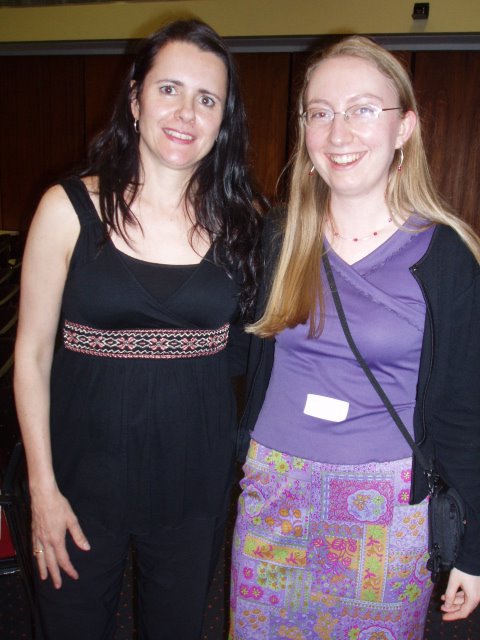
Last night’s 7:30 Report feature on the abortion drug RU486 reminded me of the pro-life conference I went to in September. Melinda Tankard Reist, whom I met for the second time at the conference, was on the 7:30 Report last night. I met her for the first time when she spoke in Hobart during May 2004. I wanted to meet Melinda after I had read her book Giving Sorrow Words. Here we are at the conference:


Reist has done an amazing job of challenging people to focus on the need to be both pro-life and pro-woman. This year she helped set up Women’s Forum Australia. This independent think tank addresses a variety of women’s issues, including work and family, and is one of the most exciting things to happen on the pro-life horizon in years. In Brisbane this week hundreds of women attended a pro-life meeting Women’s Forum Australia organised, and this was pictured on the 7:30 Report.

At the Brisbane conference I also met Dr. David van Gend, another pro-life stalwart who was on the 7:30 Report. He had many people approaching him to talk or ask questions, but he was still kind enough to answer my questions about euthanasia.

The conference was held at the Parliamentary Annex of Brisbane’s Parliament House, a lovely location. We had a BBQ on the roof. Here is a picture of the view from there:


It really seemed like a gift of God that I got to go to the conference, because I only found out about it the day before! I just “happened” to be in Brisbane to visit family, and I went to visit QLD RTL and found out just in time to go! The aim of the conference was to focus on what we can do, rather than moan about how bad everything is and get depressed. It was encouraging to hear about a pro-life, pro-woman advertising initiative that has had great success in the USA. I had read about it, and it is good to know it may come here – if the pro-life movement can find millions of dollars.

Read more...

  © Blogger template Shush by Ourblogtemplates.com 2009

Back to TOP